

Picture this: your compensation benchmarking is rigorous, your benefits package outpaces competitors, and your latest engagement survey shows satisfaction with pay. Yet your highest-potential people keep leaving. Exit interviews cite 'culture' and 'growth opportunities', frustratingly vague feedback that offers no clear path to action.
Here's what the research actually reveals: whilst you've been perfecting the visible infrastructure of employment, five hidden systems have been quietly driving talent out the door.
This isn't about 'soft' people problems. It's about hard infrastructure failures with measurable business impact. Failures that most leadership teams never systematically examine. Meetings in which 3 to 4 voices dominate 60 to 70% of airtime. Sponsorship gaps that strand high-potential talent without advocates. Feedback systems that crush rather than develop. Conflict that festers at a cost of $359 billion annually across businesses. AI hiring tools now used by 85% of companies, yet properly audited by only 30%.
For HR Directors and CPOs across European organisations, this matters more than ever. With gender quotas tightening (33 to 40% board representation now mandated in several markets), DEI reporting requirements expanding, and labour markets in which 59% of the workforce needs reskilling, these infrastructure failures aren't just retention risks. They're compliance and competitive risks.
The uncomfortable insight: talent doesn't leave because the work is hard. They leave because your systems make contribution unnecessarily difficult.
The encouraging news? These are discrete, fixable problems, not massive transformation programmes. Let's examine each one.
Culture isn't a vague aspiration you hope emerges from good intentions. Culture is the accumulated output of concrete, auditable systems.
Airtime Inequality: The Invisible Hierarchy Silencing Your Best Thinking
Research confirms what many of you have observed but struggled to quantify: in unstructured meetings, 3 to 4 people consume 60 to 70% of speaking time regardless of team size. This isn't a personality problem. It's a design problem with predictable patterns.
The data reveals specific vulnerabilities:
- Women speak 25% less in mixed-gender meetings
- Remote participants speak 35% less in hybrid settings
- Junior voices with fresh perspectives are systematically crowded out
Why This Matters for Your Retention Numbers
The talent you're losing didn't leave because they had nothing to contribute. They left because your meeting infrastructure made contribution feel pointless. When intelligent people repeatedly experience their input being overridden or ignored, they disengage, then they leave.
The Compliance Dimension
European firms facing mandatory board gender quotas and DEI reporting requirements cannot afford to ignore airtime inequality. You may be hitting representation numbers whilst simultaneously silencing the voices you worked to include. That's not inclusion. It's expensive tokenism.
What Works
Organisations implementing structured facilitation report measurably higher engagement, better decision quality, and stronger retention of underrepresented talent. The interventions aren't radical:
- Round-robin formats that guarantee speaking opportunities
- Airtime analytics that surface patterns invisible to participants
- Clear time boundaries that prevent default dominance
The Trade-Off to Acknowledge
Structured meetings can feel rigid initially, particularly to those who benefited from the previous informality. This is a feature, not a bug, but it requires framing. Position it as improving decision quality, not policing behaviour.

The Sponsorship Desert: Why High-Potential Talent Plateau Without Advocates
Mentorship is valuable. Sponsorship is transformational. The distinction matters enormously for retention.
Mentors advise. Sponsors advocate. Mentors help talent navigate. Sponsors put their own reputation on the line to create opportunities. Research shows sponsorship accelerates promotions more effectively than mentorship alone, yet underrepresented professionals have significantly lower access to sponsors.
The Market Shift You Should Know About
Formal sponsorship programmes jumped from 67% to 83% adoption in just two years. This isn't HR trend-chasing. 47% of organisations now view diverse talent pools as a strategic solution to skills gaps, up from just 10% previously. Your competitors have recognised what's at stake.
The European Labour Market Context
With 39% of current skills projected obsolete by 2030 and 59% of the workforce needing reskilling, you cannot afford to lose high-potential talent to competitors who've built better sponsorship infrastructure. This is succession planning, not charity.
Questions to Diagnose Your Sponsorship Infrastructure
- Do your senior leaders have explicit sponsorship responsibilities, or is advocacy purely informal?
- Can you map which high-potential employees have active sponsors and which don't?
- Is sponsorship distributed equitably, or does it flow through existing networks that replicate historical patterns?
The Investment Required
Sponsorship demands senior time, a genuine cost. But compare that cost to losing talent you've developed for years to a competitor who offered them visibility and advocacy. The ROI calculation favours building the infrastructure.
Feedback That Develops vs. Feedback That Destroys
The statistics are stark: only 42% of managers handle feedback effectively, yet 68% of retention can be improved through constructive feedback approaches. This gap represents one of your most addressable infrastructure failures.
The Shift That Matters
From incident-based feedback to pattern-based feedback. From criticism to growth frameworks. These distinctions determine whether talent stays and improves or leaves feeling diminished.
Consider two approaches to the same performance issue:
Incident-based: 'In yesterday's client meeting, you interrupted the client twice and missed their main concern.'
Pattern-based: 'I've noticed in several client interactions that the pace sometimes outstrips the listening. Let's work on techniques that help you hear the full picture before responding.'
The first approach triggers defensiveness. The second opens development.
What the Research Shows Works
- Structured feedback protocols (WIN framework, narrative-based reviews) correlate with 47% higher employee sentiment
- 83% of employees prefer regular feedback over annual reviews, the infrastructure exists to meet this preference
- Behaviour-based, forward-focused feedback builds capability; character-based, backward-focused feedback destroys trust
The European Context
Employee engagement across Europe is at a 10-year low. In this environment, effective feedback isn't a nice-to-have. It's a competitive differentiator. Organisations that build feedback infrastructure that develops rather than deflates will retain talent their competitors cannot.
The Skill Gap to Address
Most managers were never trained in feedback delivery. They default to what they experienced, perpetuating dysfunction. Investment in manager capability here delivers outsized returns.
The talent you're losing didn't leave because they had nothing to contribute. They left because your meeting infrastructure made contribution feel pointless.
The Bias Infrastructure: How AI Hiring Tools Amplify What You Don’t Measure
Here's the uncomfortable reality: 85% of organisations now use AI for hiring, but only 30% believe their managers handle bias effectively. If you're deploying AI systems trained on historical hiring data without rigorous auditing, you're not eliminating bias. You're automating and scaling it.
A Cautionary Example
One tech firm discovered its AI hiring system resulted in 25% fewer diverse hires before retraining. The algorithm had learnt from historical patterns that reflected past bias, then efficiently replicated those patterns at scale. The bias wasn't in the technology. It was in the data the technology learnt from.
The Regulatory Pressure You’re Facing
The EU AI Act classifies hiring systems as high-risk, with mandatory bias audits emerging across European jurisdictions. This isn't a future concern. It's a present compliance requirement. Organisations that haven't audited their AI hiring tools face both €1M+ fines and significant reputational exposure.
The Audit Framework That Works
- Algorithm transparency: Can you explain how your system makes decisions?
- Training data diversity: Does your training data reflect the workforce you want to build, or the workforce you inherited?
- Human-in-the-loop oversight: Where do humans intervene, and with what authority?
- Regular audit cadence: When did you last test for disparate impact?
The Insight to Carry Forward
Bias thrives in ambiguity. Structured measurement exposes and corrects it. The organisations achieving genuine hiring diversity aren't the ones claiming to be 'bias-free'. They're the ones systematically measuring and addressing the bias that exists in every system.
Unresolved Conflict: The €359 Billion Productivity Tax You’re Paying
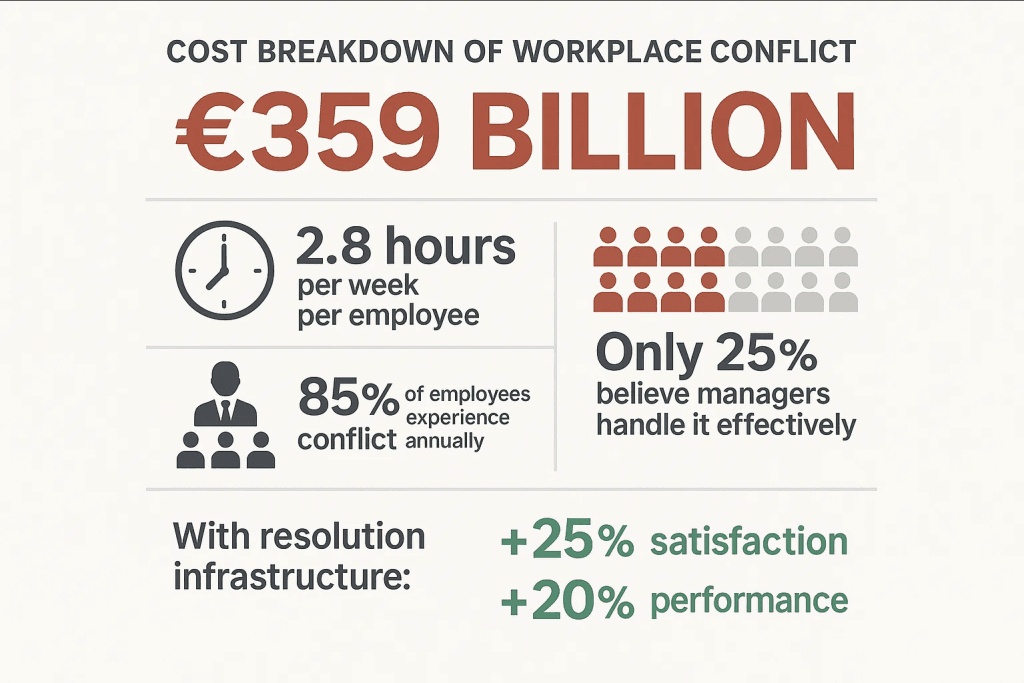
85% of employees experience workplace conflict annually. The cost across businesses: $359 billion in lost productivity. The average time burned: 2.8 hours per week per employee on unresolved conflict.
Yet only 25% of workers believe their managers handle conflict effectively.
Why Conflict Escalates
Not because people are difficult, but because there's no clear process to reach closure. Without infrastructure for resolution, disagreements fester, relationships calcify, and productive tension converts to destructive standoff.
The Hybrid and Matrix Complication
European organisations increasingly operate across time zones, reporting lines, and working arrangements. These structures make conflict more likely whilst simultaneously making resolution harder. The colleague you disagree with may be in a different country, on a different schedule, reporting to a different leader. Without explicit resolution infrastructure, these conflicts simply persist.
What Conflict-Competent Organisations Do Differently
- Implement structured resolution frameworks (5-step processes that move from issue identification to committed alignment)
- Train managers in early intervention before positions harden
- Provide neutral facilitation for conflicts that exceed manager capability
- Distinguish between productive disagreement (valuable) and destructive conflict (costly)
The Results
Organisations with conflict resolution infrastructure see 25% higher satisfaction and 20% better performance. Not because they eliminated disagreement, productive teams aren't conflict-free. They converted destructive standoffs into committed alignment through repeatable processes.
The Reframe for Your Leadership Team
You're not asking for a 'softer' culture. You're asking to stop paying a productivity tax that exceeds what most organisations spend on their entire people function.
What This Means for Your Organisation
Here's the pattern these five infrastructure failures share: none of them show up in your compensation benchmarking. None appear in your benefits analysis. None are captured by surveys asking whether employees feel 'satisfied with pay.'
They hide in plain sight. In meetings where bright people go silent, in high-potential talent who plateau without sponsors, in feedback conversations that leave people smaller rather than stronger, in hiring systems that replicate yesterday's workforce, in conflicts that burn hours and relationships without resolution.
The Reframe This Demands
Culture isn't a vague aspiration you hope emerges from good intentions. Culture is the accumulated output of concrete, auditable systems. Fix the systems, and the culture follows.
For HR Directors and CPOs Navigating This
You're often fighting uphill against infrastructure you didn't design. These problems predate your tenure. But the research offers something actionable: these aren't intractable 'people issues' requiring wholesale transformation. They're discrete system failures with proven interventions.
Your Diagnostic Starting Point
- Audit airtime distribution in your critical meetings
- Map sponsorship coverage across your high-potential population
- Assess manager feedback capability with honest measurement
- Review AI hiring tool audit history and frequency
- Evaluate whether conflict resolution infrastructure exists or whether you're relying on individual manager improvisation
The talent you're losing isn't leaving because the work is too hard. They're leaving because your invisible infrastructure made contribution harder than it needed to be. That's frustrating, but it's also fixable.
And in European labour markets where skills scarcity, regulatory pressure, and engagement decline converge, the organisations that fix this infrastructure first will retain the talent their competitors keep losing to problems they never thought to examine.
If your organisation is facing retention challenges despite strong compensation, our organisational design and leadership development programmes can help you diagnose and fix these hidden infrastructure failures. Get in touch to explore how we can support your people strategy.
Veritern's consulting services for business transformation and organisational capability development
Guidance from Clifford Chance on EU AI Act implications for employers
