
Picture this: A fintech CTO, under pressure to demonstrate AI capability, greenlights a nine-month custom build. Six months in, the team discovers the underlying business case was flawed. The problem they were solving wasn’t actually the bottleneck. €80k spent. Team morale fractured. Board confidence shaken.
Now consider the alternative: that same CTO starts with OpenAI’s API, proves a 30% improvement in call handling within eight weeks, then builds a custom LLM that delivers 40% cost reduction and genuine competitive differentiation.
You haven’t earned the right to build until you’ve proven you should.
Same ambition. Radically different outcomes.
The research is unequivocal: 75% of AI projects fail to deliver business value. Only 10% of companies with internal AI labs report positive ROI within twelve months. Yet organisations that secure quick AI wins in year one are twice as likely to achieve long-term success.
The uncomfortable truth? Build-versus-buy is the wrong question. The right question is: when do you build, and have you earned that right?
This framework will transform how you evaluate AI investments, replacing gut instinct with a sequenced strategy that delivers sustainable ROI 60% faster than jumping straight to custom development.
The Costly Mistake: Why Building Too Early Is Just as Dangerous as Buying Too Late
The pressure to adopt AI is real. With 26.1 million European SMEs navigating digital transformation and micro-SMEs leading adoption rates, standing still isn’t an option. But the data reveals a counterintuitive pattern: the companies most eager to build are often the ones most likely to fail.
The validation trap manifests in three familiar ways
- A product team convinced their use case is unique
- A founder who’s seen a competitor announce AI capabilities
- A CTO who believes in-house talent can outperform off-the-shelf solutions
None of these are wrong instincts. But acting on them before validation is where 75% of AI investments go to die.
The ‘earn the right to build’ principle
Before committing to custom development, you must prove three things with bought tools:
- The use case solves a real, measurable business problem
- The solution delivers visible, fast, and safe results
- The limitations of bought solutions genuinely constrain your growth
This isn’t about lacking confidence in your team. It’s about respecting the reality that 68% of AI failures stem from misaligned people and processes, not technology. Bought solutions force you to confront business case validity before you’ve invested six figures in code.
Ask yourself
- Have you proven this use case with someone else’s infrastructure first?
- Can you articulate specifically why off-the-shelf won’t work, with data, not intuition?
- What would you learn in a twelve-week pilot that you can’t learn any other way?
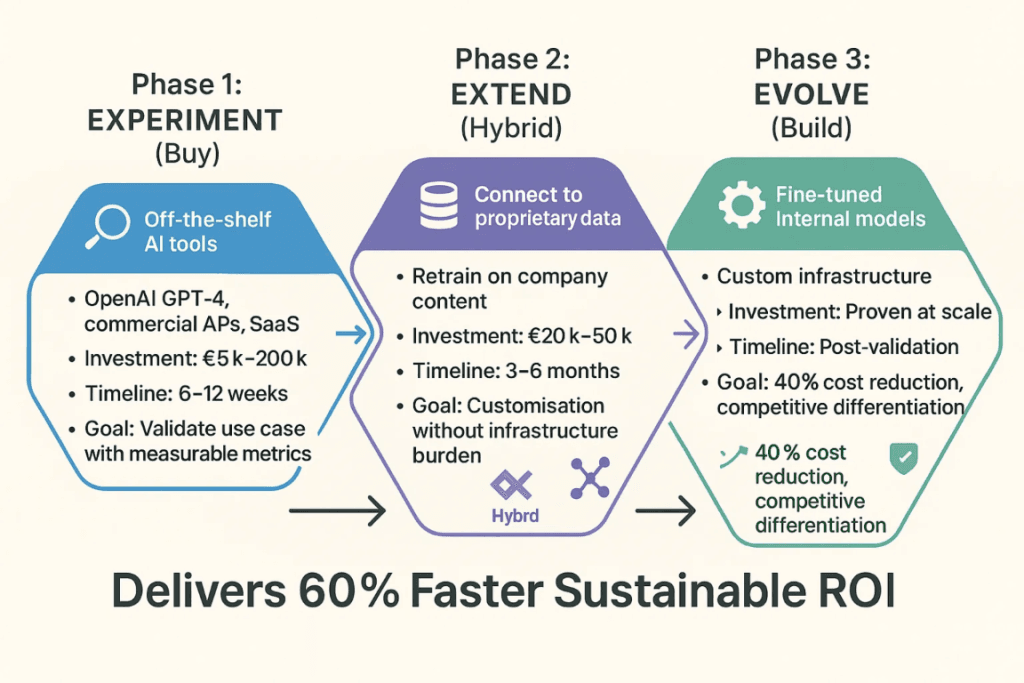
The 3-Phase Maturity Ladder: Experiment, Extend, Evolve
The smartest SMEs don’t choose build or buy. They master the sequence. Here’s the pathway delivering 60% faster sustainable ROI.
Phase 1: Experiment (Buy)
Deploy off-the-shelf AI tools to validate use cases quickly with minimal investment. This means OpenAI GPT-4, commercial APIs, or vertical-specific SaaS solutions.
Your goal isn’t perfection. It’s proof.
What does success look like?
- Measurable improvement in a specific metric (response time, accuracy, throughput)
- User adoption data showing the solution addresses real workflows
- Clear understanding of where the bought solution falls short
Typical investment: €5k to €20k. Timeline: 6 to 12 weeks.
Phase 2: Extend (Hybrid)
Connect bought tools to your proprietary data. Retrain on company-specific content. Create hybrid architectures that customise without requiring full ownership.
65% of enterprises now operate in this hybrid model, and for good reason. You gain:
- Customisation without infrastructure burden
- Proprietary advantage from your unique data
- Reversibility if the approach doesn’t scale
Typical investment: €20k to €50k. Timeline: 3 to 6 months.
Phase 3: Evolve (Build)
Build fine-tuned models on internal infrastructure once, and only once, the business case is proven at scale. This unlocks:
- Cost savings (40% reduction in proven examples)
- Performance gains tailored to your specific needs
- Competitive differentiation that’s genuinely defensible
Transition triggers to watch for
- Volume caps on commercial APIs becoming cost-prohibitive
- Feature restrictions blocking critical functionality
- Competitive advantage requiring proprietary capabilities
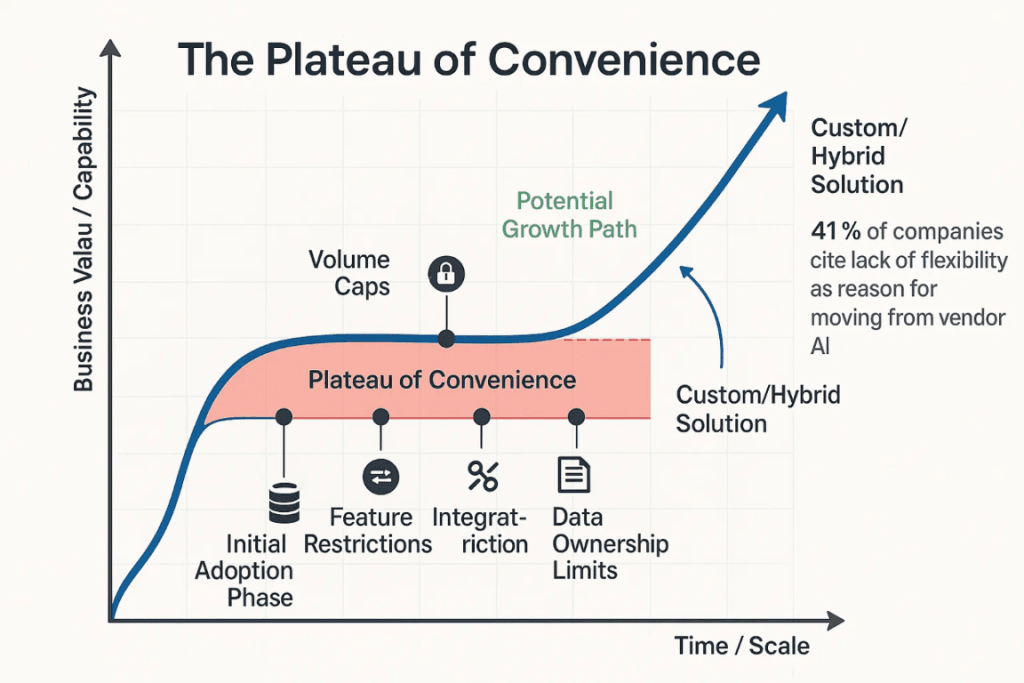
- The ‘plateau of convenience’ (when 41% of companies realise flexibility limits are constraining growth)
Every organisation that’s succeeded with custom AI built it second—after proving the case with someone else’s infrastructure first.
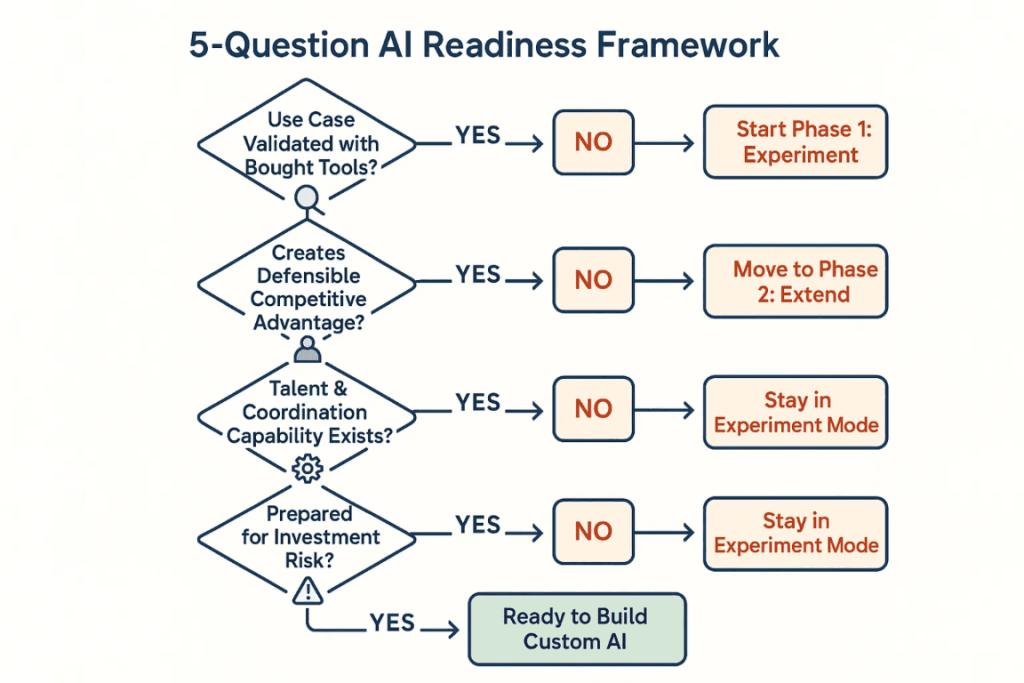
The 5-Question Decision Framework: Where Are You Really?
Before your next AI investment decision, run this diagnostic. These aren’t feature checklists. They reveal organisational readiness, not just technical feasibility.
1. Use Case Validation
Have you proven this solves a real problem with bought tools first?
If yes: You’ve earned the right to consider building.
If no: Stop. Start with Phase 1 (Experiment). No exceptions.
2. Competitive Advantage
Will custom AI create defensible differentiation, or is ‘good enough’ sufficient?
Honest assessment required. Most operational efficiency gains don’t require custom builds. Competitive differentiation, where AI becomes your product or core capability, often does.
3. Talent Readiness
Do you have, or can you afford, the technical and coordination capability to build and maintain?
Remember: 68% of AI failures stem from people and process issues. This isn’t just ‘do we have developers?’ It’s:
- Do we have cross-functional collaboration maturity?
- Can we sustain the experimentation culture required?
- Who owns ongoing model performance?
4. Sustainability
Can you support ongoing model retraining, monitoring, and updates long-term?
Building is 30% of the cost. Maintaining is 70%. If you don’t have a credible answer for year two and beyond, you’re not ready.
5. Risk Tolerance
Are you prepared for the investment timeline and potential failure cost?
Even with compressed timelines, custom builds carry more uncertainty than bought solutions. Is your organisation (board, investors, team) prepared for that variance?
Your decision matrix
- All five answered ‘yes’: Ready to build
- Three or four ‘yes’: Move to hybrid (Phase 2)
- Fewer than three: Stay in experiment mode (Phase 1) until you can answer honestly
The Hidden Invoice of AI Convenience: What to Negotiate Before You Sign
Every SaaS AI shortcut comes with a long-term cost. 41% of companies cite lack of flexibility or customisation as their primary reason for eventually moving from vendor AI to internal development. This creates what researchers call the ‘plateau of convenience’, where bought solutions can’t scale with your growth.
The trap isn’t the bought solution itself. It’s failing to plan the exit strategy from day one.
What the plateau looks like
- Volume caps making per-transaction costs prohibitive at scale
- Feature restrictions blocking capabilities you’ve now validated as essential
- Integration friction preventing connection to critical internal systems
- Data ownership constraints limiting your ability to train on your own outputs
What to negotiate upfront (before you sign)
Data portability:
- Can you export all data, including model outputs and training data?
- In what format? How quickly?
- What happens to your data if the vendor is acquired or shuts down?
Transition rights:
- Are there contractual restrictions on moving to a competitor or building internally?
- What’s the notice period? Exit costs?
Scaling economics:
- What happens to per-unit costs at 10× volume? 100×?
- Are there committed use agreements that could trap you?
Thresholds to monitor monthly
- API costs as percentage of value delivered
- Feature requests that vendors can’t or won’t implement
- Integration workarounds that are becoming technical debt
Organisations with clear vendor evaluation criteria experience 60% fewer post-deployment issues. This discipline transforms bought solutions from potential traps into genuine stepping stones.
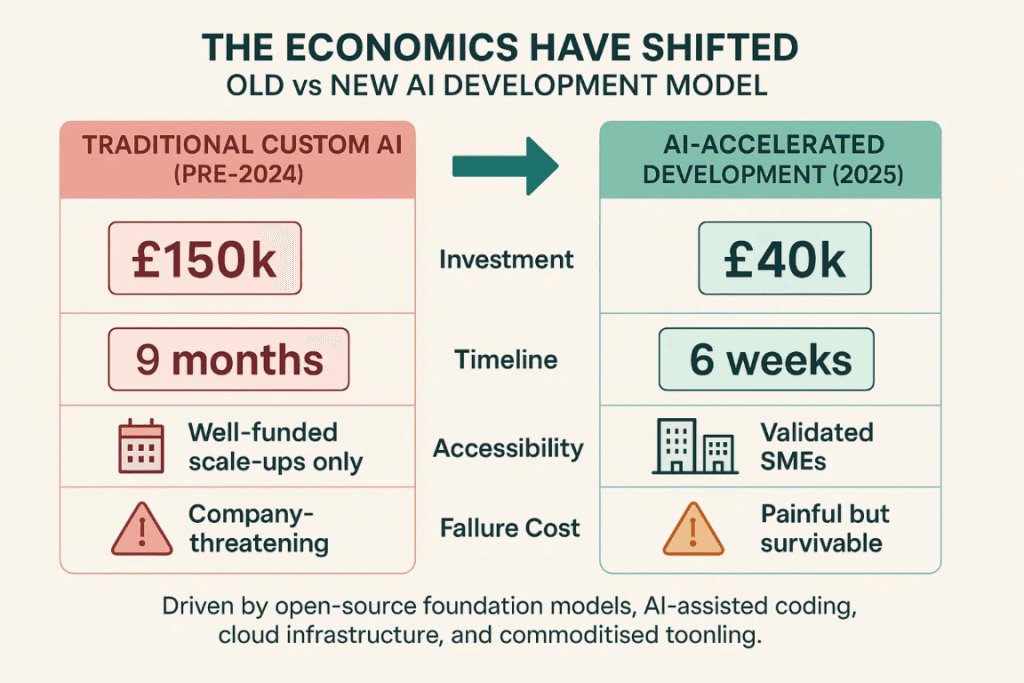
The Economics Have Shifted: What €40k and Six Weeks Now Buys You
Here’s the development that changes everything for SME leaders: AI-accelerated development tools have dramatically compressed custom build costs and timelines.
The old economics
- Custom AI project: €150k investment, 9-month timeline
- Accessible only to well-funded scale-ups and enterprises
- Failure cost: potentially company-threatening
The new economics
- Equivalent capability: €40k investment, 6-week timeline
- Viable for SMEs with validated use cases
- Failure cost: painful but survivable
This isn’t marketing hyperbole. The compression is real, driven by:
- Open-source foundation models reducing development starting points
- AI-assisted coding accelerating development velocity
- Cloud infrastructure eliminating capital expenditure requirements
- Commoditised tooling for deployment and monitoring
What this means for your sequencing strategy
The barrier to Phase 3 (Build) has dropped dramatically, but the strategic discipline to validate first hasn’t changed. In fact, it’s more important now.
Why? Because lower costs tempt organisations to skip validation. ‘It’s only €40k, let’s just build it.’ That’s how you waste €40k and six weeks discovering your use case was flawed.
The European SME context
With 1.6% projected value-added growth in 2025 and micro-SMEs leading digital adoption, European SMEs are positioned to leverage this cost compression. But success still depends on:
- Cross-functional collaboration maturity
- Reskilling investment for existing teams
- Experimentation culture that accepts intelligent failure
The financial barrier to building has dropped. The organisational capability gap remains the real constraint.
Where You Should Be Right Now
The most expensive AI decision you’ll make isn’t choosing the wrong vendor or building the wrong feature. It’s getting the sequence wrong.
Building before you’ve validated wastes six months and €100k on unproven assumptions. Buying without an exit strategy traps you at the plateau of convenience. The staged pathway (Experiment, Extend, Evolve) delivers sustainable ROI 60% faster because it aligns investment with evidence.
Here’s where you should be right now:
If you haven’t validated your use case with bought tools: Start there. Spend €10k and eight weeks proving the business case before any build conversation.
If you’ve validated but hit flexibility limits: Move to hybrid. Connect commercial AI to your proprietary data and measure the incremental value.
If you can answer ‘yes’ to all five framework questions: You’ve earned the right to build. The economics now support it. Go.
The pressure to adopt AI is real, and appropriate. SMEs that fail to integrate AI capabilities will struggle to compete. But the path to sustainable AI advantage runs through disciplined sequencing, not heroic leaps.
Every organisation that’s succeeded with custom AI built it second, after proving the case with someone else’s infrastructure first.
You haven’t earned the right to build until you’ve proven you should.
Check us out. I’m sure we can help: https://veritern.com/consulting-services/
Further reading: https://link.springer.com/article/10.1007/s11187-025-01017-2




0 Comments